
Countywide
Kern County Museum and Beyond: A Complete Guide
From 56 historic buildings on 16 acres in Bakersfield to a gold-mining museum in a Mojave ghost town, Kern County's museums cover real history.
Updated September 2026
The Kern County museum landscape is large enough, and historically varied enough, that it doesn’t cluster around one story. A visitor can trace the county’s agricultural and oil-boom past in Bakersfield, the birth of a whole genre of country music, the natural history of the northern Mojave Desert, and the gold-rush-era mining camps of the high desert, all within roughly a two-hour drive of each other.
Kern County Museum (Bakersfield)
The largest and most complete of the county’s museums, Kern County Museum sits on 16 landscaped acres at 3801 Chester Ave in Bakersfield. Rather than one building, it’s an outdoor history park of more than 50 relocated and reconstructed historic structures (a one-room schoolhouse, a general store, a jail, an oil derrick, and roughly a half-dozen original historic homes moved to the site) alongside indoor galleries covering Native American history, mining, agriculture, the railroad, and the Bakersfield Sound. It’s open Wednesday through Sunday, 9 a.m. to 4 p.m., and is closed Mondays and Tuesdays. Its collection keeps growing: the famous penny-covered bar from McKittrick’s Penny Bar & Cafe, a small oil-town landmark that closed in 2022, was donated to the museum in 2024.
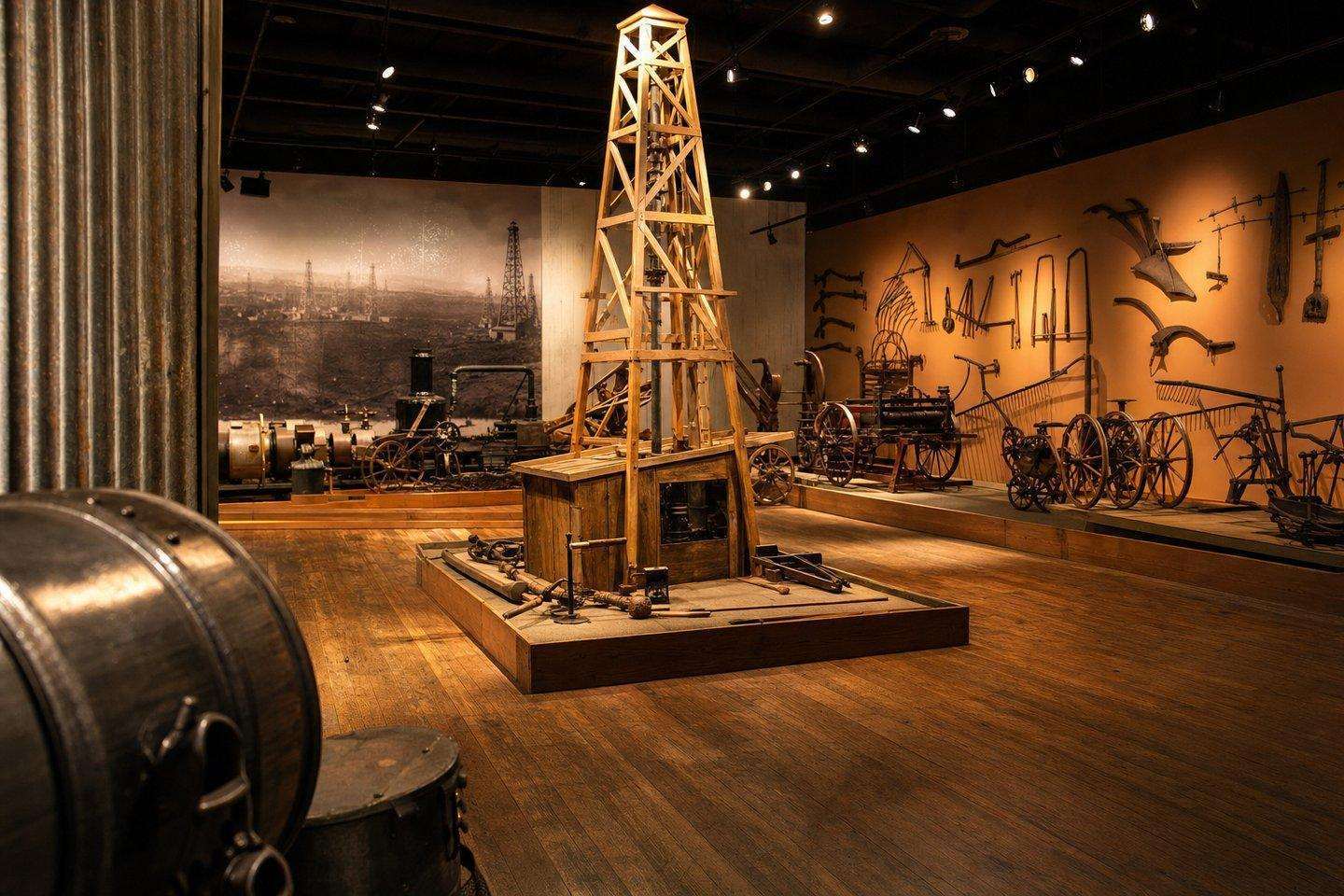
Because it covers oil, agriculture, railroads, and music side by side, it’s the single best starting point for understanding how a farm-and-oil county became known nationally for a country-music sound.
Buena Vista Museum of Natural History (Bakersfield)
Also in Bakersfield, the Buena Vista Museum of Natural History focuses on paleontology: specifically the marine and land fossils pulled from the oil-bearing foothills around the city, centered on its Sharktooth Hill fossil collection. Kern County’s oil fields have long turned up fossils alongside crude, and the museum’s collection reflects that overlap between the county’s two big 20th-century industries, energy extraction and natural history. Our Sharktooth Hill and fossil-collection deep dive covers the science and the museum’s own dig trips in more depth.
California Living Museum, CALM (Bakersfield)
CALM is a native-species zoo and botanical garden rather than a history museum: a rescue facility for animals that were injured or otherwise can’t survive in the wild, including bobcats, mountain lions, bighorn sheep, and a raptor exhibit with bald eagles and long-eared owls. It’s a useful stop for families mixing museum-going with something closer to a wildlife park. Our full CALM guide covers hours, admission, and what makes its animal collection different from a typical zoo.
Tehachapi Heritage Museum
Up in the mountains, Tehachapi has two small museums worth pairing on the same visit. The Tehachapi Heritage Museum, at 310 South Green Street, occupies an Art Deco building constructed in 1931 that served for decades as a branch of the Kern County Library before the Tehachapi Heritage League took it over in 1982. It’s open Saturday and Sunday, noon to 4 p.m., and covers the town’s history from its founding, largely tied to the arrival of the railroad in 1876.
Tehachapi Depot Railroad Museum
A short walk away, the Tehachapi Depot Railroad Museum is housed in the town’s original 1904 Southern Pacific Railroad depot, a building listed on the National Register of Historic Places since 1999. The museum itself was established in 2009 and focuses on the railroad history that put Tehachapi on the map, including the famous Tehachapi Loop just outside town, where the track spirals over itself to gain elevation through the pass (see our Tehachapi Loop guide for the full story).
Maturango Museum (Ridgecrest)
Out in the high desert, the Maturango Museum in Ridgecrest has covered the natural and cultural history of the northern Mojave Desert since 1962. Exhibits range across the region’s geology, plant and animal life, and Native American artifacts, alongside contemporary art and craft work from local desert artists. It’s open daily, 10 a.m. to 5 p.m. (closed on major holidays), at 100 E. Las Flores Avenue.
Rand Desert Museum (Randsburg)
Perhaps the most specific of the county’s museums, the Rand Desert Museum sits in Randsburg, a real, still-standing mining boomtown that never fully emptied out after its gold rush. The museum, at 161 Butte Avenue, preserves the history and artifacts of the Rand Mining District, once home to one of California’s largest gold-mining operations. It keeps limited hours (Saturdays and Sundays, 11 a.m. to 2 p.m., or by appointment for groups), so it’s worth checking ahead if Randsburg is on a day-trip itinerary.
Kern Valley Museum (Kernville)
In the mountain town of Kernville, on the shore of Lake Isabella, the Kern Valley Museum covers the history of the Kern River Valley, including the mining and ranching era before the Isabella Dam changed the shape of the valley in the 1950s.
Planning a museum day
Because the Kern County museum scene splits cleanly by region, a single day trip rarely covers more than one cluster: Bakersfield’s three museums pair naturally together, Tehachapi’s two small museums fit into an afternoon, and the desert museums (Maturango in Ridgecrest, Rand Desert in Randsburg) are close enough to combine if you’re already out that way. Check individual museum hours before visiting: several, especially the smaller ones, keep limited weekend-only schedules.
Frequently Asked Questions
What are the must-see museums in Kern County?
Kern County Museum in Bakersfield is the largest and most complete: a 16-acre outdoor history park with over 50 relocated historic buildings. For a different angle, Maturango Museum in Ridgecrest covers the natural and cultural history of the northern Mojave Desert, and Rand Desert Museum in Randsburg preserves the county's real gold-mining history.
Is there a museum specifically about the Bakersfield Sound?
Kern County Museum's galleries include a dedicated Bakersfield Sound exhibit alongside its agriculture, mining, and railroad history displays. It's the best single stop for that history in physical-artifact form.
Are Kern County's museums open every day?
No, several of the smaller ones, including Tehachapi Heritage Museum and Rand Desert Museum, keep limited weekend-only hours. Kern County Museum is open Wednesday through Sunday. Check individual hours before a trip, especially for the smaller desert and mountain museums.
Can I visit multiple Kern County museums in one day?
Realistically, plan around clusters rather than the whole county: Bakersfield's three museums (Kern County Museum, Buena Vista Museum of Natural History, CALM) pair naturally together, Tehachapi's two small museums fit into an afternoon, and the desert museums (Maturango in Ridgecrest, Rand Desert in Randsburg) are close enough to combine on a dedicated desert day.
Is there a railroad museum in Kern County?
Yes, the Tehachapi Depot Railroad Museum, housed in the town's original 1904 Southern Pacific depot (a National Register of Historic Places building since 1999), covers the railroad history behind the famous Tehachapi Loop nearby.